

.png)

When you keep money in a bank, you do not hold it yourself. The bank holds it for you. It keeps a record of what you are owed and gives you ways to move that balance around, and the whole thing works because you trust the institution to honour the record. Most money in the world is held this way, by someone else, on your behalf.
Self-custody is the alternative. It removes the middle layer, so that you hold your money directly.
That sounds simple, but it changes something basic about ownership, and it carries trade-offs worth understanding before you decide whether it is for you. This piece explains what self-custody is, and why it has become far easier to live with than it once was.
What is self-custody?
Self-custody means holding your own assets, with no third party keeping them for you. You control the credentials that authorise any movement of your funds, which means no outside company can move or freeze them without you.
The contrast is with custody, where a provider holds your money and acts on your instructions. A bank is custodial. So is a crypto exchange that keeps your coins in its own accounts. In both cases you do not hold the asset itself. You hold a claim against the institution, and you depend on it staying solvent and willing to honour that claim.
Custodial or self-custodial: who holds your money
Almost everyone has only ever used custodial money, so it can be hard to notice the assumption underneath it. When your balance sits with a bank or an exchange, what you own is a promise. The provider has the money. You have the right to ask for it back.
Most of the time that promise holds. Sometimes it does not. When an exchange becomes insolvent or freezes withdrawals, the people whose money sat inside it find that their access was never fully theirs. A run of high-profile failures over the past few years made this concrete for a lot of people, and gave self-custody its blunt rallying phrase: not your keys, not your coins.
Self-custody turns this around. The provider gives you software to manage your money but never takes possession of it. You do not ask permission to move your own funds, because nobody else is holding them.
Why self-custody used to be so hard
If self-custody is the safer option in principle, why has most of the world stayed custodial? The honest answer is that, for most of its history, self-custody was difficult and unforgiving.
Traditionally, holding your own crypto meant managing a seed phrase: a list of twelve or twenty-four words generated when you set up a wallet. Those words are the master key to the account. Anyone who has them controls the funds. Lose the words, and the money is gone.
This created a harsh trade-off. There is no reset button and no support line that can recover a lost phrase, so a misplaced scrap of paper can lock money away for good. Analysts have estimated that a large share of all bitcoin, on the order of millions of coins, is now unreachable, much of it behind keys that were lost or forgotten. The same phrase could also be stolen. A convincing fake website or message only had to persuade someone to type those words in once.
So self-custody offered real control, but it asked ordinary people to act as their own security desk, with no margin for a single mistake. Understandably, most preferred to let someone else carry that burden.
How self-custody works without a seed phrase
The more recent shift in self-custody is about removing that single point of failure, and it is the reason the idea is becoming usable for people who are not crypto enthusiasts.
The change starts with what a wallet is. Older wallets were controlled by one private key, sitting behind one seed phrase. Newer ones are built as smart accounts, small programs on the blockchain that can set their own rules for what counts as valid authorisation and how access can be restored. In the wider industry this is known as account abstraction.
On top of that sits the passkey. A passkey is a cryptographic credential stored on your device and unlocked with your fingerprint, face or a PIN, the same method that now signs you into many apps without a password. Two properties make it well suited to money. The apps you log into never receive the secret itself, only a one-off signature, so there is nothing in a company database for a breach to steal. And the credential works only on the genuine app it belongs to, which means a counterfeit page cannot trick you into approving anything. There is no phrase to write down, and nothing for a scammer to talk out of you.
The result is an account that you alone control, without the brittle backup ritual that kept self-custody out of reach for so long.
What happens if you lose access?
This is the first question any sensible person asks, and for good reason. If you truly hold your own money, what stops a lost or broken phone from erasing it?
With a seed phrase, the answer used to be nothing. A smart account can do better, because its rules can include a way to recover access. The common method is social recovery. You choose one or more trusted people in advance and give them a narrow role: if you ever lose your device, they can approve restoring your access on a new one. They can never see your balance or move your money, and a built-in waiting period gives you time to halt an attempt you did not start.
This keeps the arrangement self-custodial. No company holds a master key or a backdoor, yet you are no longer one accident away from losing everything. The important caveat is that recovery only works if you set it up beforehand. Arrange nothing, then lose your only means of access, and the money can still be lost.
What self-custody protects you from, and what it does not
Self-custody removes a specific risk: the chance that the institution holding your money fails you, whether through insolvency or a freeze imposed on your account. Because no one else is holding the funds, no one else can lose or withhold them.
It does not remove every risk, and it is worth being plain about what stays in your hands. Blockchain transactions are final, so a payment sent to the wrong address cannot be reversed by an appeal to support. Responsibility for access sits with you, softened but not erased by recovery. And self-custodial balances are not covered by government deposit protection. Schemes such as the Deposit Guarantee Scheme in the EU and the FDIC in the United States exist to repay depositors if a bank collapses, and they apply to bank deposits, not to money you hold yourself. That is not a hidden flaw. It is how self-custody differs from a bank, and worth understanding before you rely on it.
How Moneda approaches self-custody
Moneda is built as a self-custodial platform, which means your money is yours to hold rather than ours to keep. Your balance is held as regulated stablecoins, EURC and USDC, on the Base network. We do not hold or control those funds, and we cannot move or freeze them. Only you can.
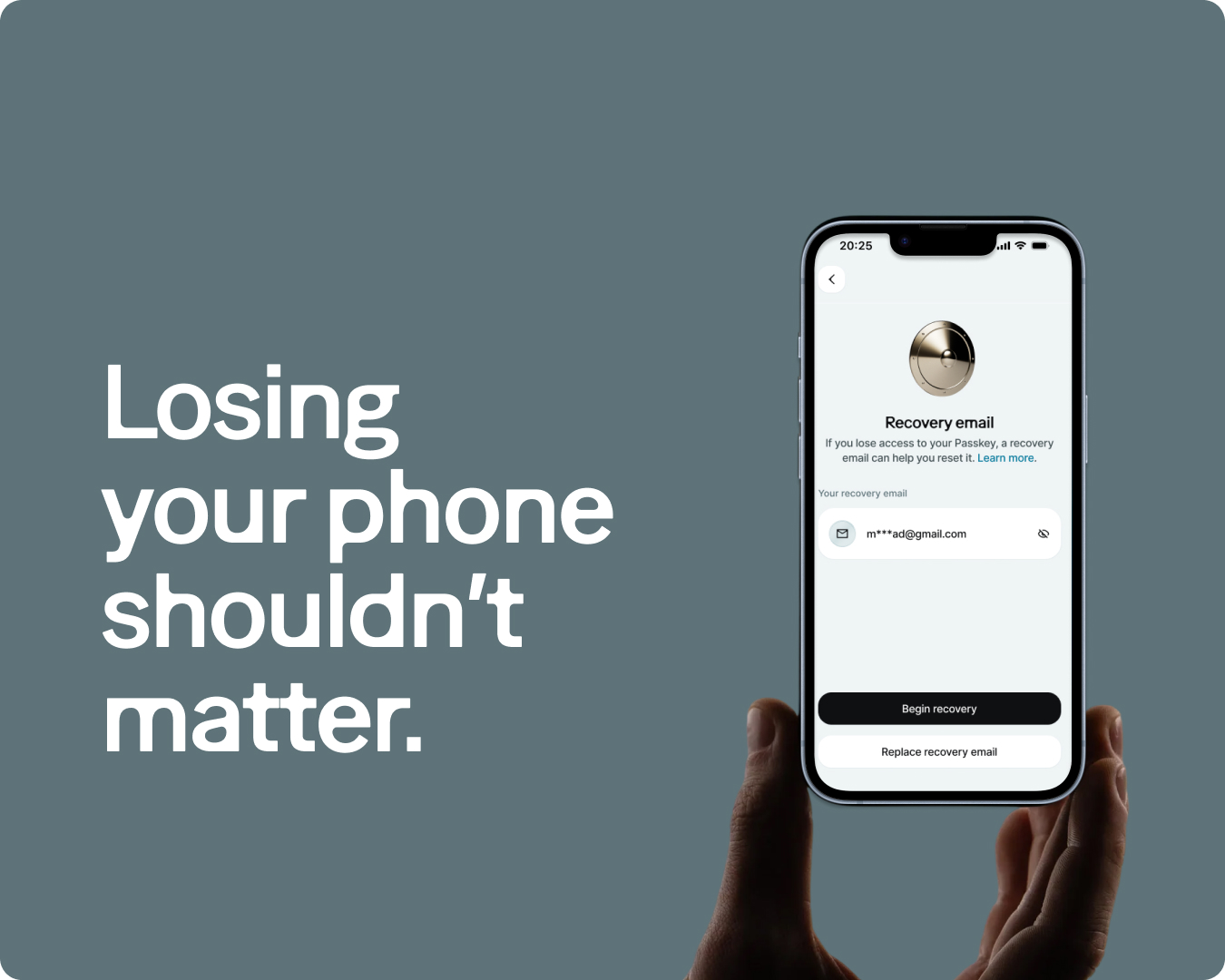
Access works through a passkey rather than a seed phrase, so there is no list of words to store or lose. On its own a single key would still be a weak point, which is why Moneda uses social recovery through Recovery Contacts. You nominate people you trust, and if you lose your passkey they can help you regain access through an on-chain process with a safety delay, without ever being able to touch your money. Recovery Contacts only protect you if they are in place before anything goes wrong.
The limits are worth stating plainly, too. Money held in Moneda is not covered by the Deposit Guarantee Scheme or the FDIC, because self-custody is not a bank deposit. And because your account lives on a public network and answers to your key, it does not depend on Moneda continuing to exist. Were the company to go away, the funds would still be yours, held where they have always been rather than on our books.
Self-custody is not the right fit for everyone, and it asks a little more understanding than handing your money to an institution and forgetting about it. What it offers in return is a simpler answer to an old question. When you hold your own money, you never have to wonder who really has it.